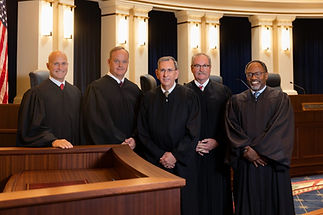
Oklahoma Court of Criminal Appeals
Oklahoma Court of Criminal Appeals
The Oklahoma Court of Criminal Appeals (OCCA) was supposed to be the safeguard in Daniel Holtzclaw’s case — the final check against bad policing, bad science, and bad prosecutions. Instead, the Court became part of the machinery that kept an innocent man in prison.
What followed was not appellate “review,” but institutional self-protection: secret hearings, contradictory orders, broken rules, scientific distortions, and a pattern of decisions that blocked the truth at every turn.
1. The Secret Hearings: A Courtroom Without a Defense
In 2017, the OCCA authorized a set of closed-door proceedings to investigate serious concerns about the State’s star forensic witness, Elaine Taylor.
On paper, the Court described these as “in camera hearings.” In reality, they were ex parte communications - meetings at which only State-aligned actors were allowed inside:
-
The Oklahoma Attorney General
-
The Oklahoma County District Attorney
-
The Oklahoma City Police Department
-
The Oklahoma City civil attorney — whose job was to defend the City in the civil suits tied to Daniel's case
Daniel's attorneys were barred from attending.
No defense presence. No cross-examination. No objections. No ability to confront witnesses or shape the record.
Then came the Catch-22:
-
The OCCA ordered the hearings.
-
The OCCA excluded the defense from those hearings.
-
The OCCA later declared the hearings “irrelevant” to avoid reviewing the problems revealed in them.
This is not judicial oversight. This is a circular loophole designed to prevent scrutiny.
And when appellate counsel objected that Holtzclaw had been denied representation at a critical stage, the OCCA shrugged and announced that this total exclusion was “harmless” — because counsel was allowed to read a transcript after the damage was done.
Reading a transcript is not participating in a hearing.
The Constitution guarantees counsel during the proceeding, not after it.
2. Science Behind Closed Doors: Rejecting Experts, Embracing Illiteracy
Just weeks before those secret hearings, six internationally-respected forensic scientists attempted to file an amicus brief warning the Court that the DNA evidence used to convict Daniel was unreliable, contaminated, and misunderstood.
The OCCA rejected the brief without explanation.
Six days later, the Court held secret hearings on that exact same topic — the validity of the DNA testing. But the only “experts” allowed inside were OCPD’s own embattled crime-lab staff and a prosecutor desperate to defend his lies at trial.
The result was a scientific echo chamber.
The Court then doubled down on mistakes that no honest scientist would make:
-
When independent experts proved the pants contained male DNA that the State had never reported, the OCCA dismissed the finding as irrelevant, missing the point entirely: male DNA destroys the prosecution’s theory that the DNA on the fly could have only gotten there via vaginal fluids. (Males do not secrete vaginal fluids.)
-
The Court claimed the DNA “only affected” the three counts involving Adaira Gardner--an absurd claim given the huge influence the DNA had on the jury.
in later testimony — after Daniel’s direct appeal had been filed — Gardner confirmed what the prosecution’s strategy really was: she stated that prosecutor Gayland Gieger told her that her testimony was needed to buttress the other accusers. In other words, even the prosecution acknowledged that Gardner’s case was never isolated.
3. Protecting Prosecutorial Misconduct
Instead of correcting misconduct, the OCCA excused it.
The “Vaginal Fluid” Lie
Prosecutor Gayland Gieger told the jury it was a fact that the DNA on the pants came from “vaginal fluid.” But Taylor — his own analyst — said she told Gieger before trial she did not know the source.
-
No fluid tests were performed.
-
No fluid was identified.
-
No “vaginal secretion” analysis exists in forensic science without specific testing.
Moreover:
-
No stains were observed on the fly when the pants were collected.
-
The quantity of female DNA on the fly of the pants was very low, effectively rebutting the allegations (i.e., that Daniel raped two women through the fly of his pants for extended periods of time the night before the pants were collected).
Despite this, the OCCA called Gieger’s lie a “reasonable inference.”
The Erection Fabrication
Gieger told the jury: “Those are his words: ‘I cannot remember if I got an erection.’”
That was false.
Daniel said: “I don’t think I did. I’m pretty positive.”
The OCCA claimed this distortion was not a misstatement at all.
4. A Court in Chaos: Broken Rules, Hidden Orders, Back-Dating
The OCCA’s handling of Daniel's appeal produced a procedural mess that cannot be mistaken for normal judicial practice.
Acting on a Motion That Never Existed
The Court took action based on a secret motion from the Attorney General that was never filed with the Court — in direct violation of its own Rule 1.13(K).
Back-Dating the Docket
Entries were assigned earlier dates to obscure when decisions were actually made.
Hiding Protective Orders
Orders that are required to be public under Rule 2.7 were concealed for months.
The “Gauntlet”
When the Court finally allowed Daniel's lawyers to view sealed exhibits from the secret hearings, it imposed absurd restrictions:
-
No copying
-
No scanning
-
No photographs
-
Documents could only be viewed in person, in Oklahoma City
-
Many exhibits were faded or illegible — so small that counsel needed a magnifying glass.
This was not transparency. This was obstruction disguised as access.
Experts Not Allowed For Eight Years
On June 14, 2018, the Court denied defense-expert access to documents central to impeaching Ms. Taylor [OCCA Order Denying Motion to Unseal Proceedings, June 14, 2018], yet in 2025 authorized the same access [OCCA Order Granting Appellant’s Motion to Review Sealed Documents, August 25, 2025]. This reversal—occurring seven years later without any intervening change in law or material factual development—underscores the arbitrariness of OCCA's decisions and demonstrates that the earlier denial lacked any legitimate legal justification. The arbitrary denial of access to evidence critical for impeaching the State's key forensic witness deprived Mr. Holtzclaw of due process for seven years.
5. Ratifying the Cover-Up: Suppression and Destruction of Evidence
The “Personnel File” Trick
OCPD forensic analyst Elaine Taylor’s misconduct was hidden under the bogus label of “personnel file,” even though these documents had nothing to do with HR and everything to do with scientific credibility.
The OCCA endorsed this tactic — effectively giving the State a blueprint for burying impeachment evidence in future cases.
Deleting the Analyst’s Email Account
During Daniel’s pending appeal, the City of Oklahoma City deleted the entire email account of Elaine Taylor — the lab analyst whose testimony underpinned the DNA evidence.
The OCCA called the destruction “moot” because the State promised not to delete anything else in the future.
But the harm was already done.
Worse, the Court faulted Daniel’s appellate attorney for not proving what the deleted emails contained — an impossible standard, and the very definition of circular reasoning:
You cannot prove the contents of destroyed evidence, and the Court uses that impossibility as the reason to deny relief.
This is not justice.
It is an institutional cover-up.
The Bottom Line: A Closed System Protecting Itself
The OCCA did not behave like a court interested in truth. It behaved like a court interested in protecting a conviction and shielding institutions:
-
Secret hearings with no defense
-
Rejecting independent scientists while embracing flawed State witnesses
-
Calling lies “reasonable”
-
Calling prejudice “harmless”
-
Hiding misconduct behind “personnel file” labels
-
Allowing destruction of key evidence mid-appeal
-
Using procedural traps to avoid confronting the truth
Every step moved in one direction: Preserve the conviction at all costs.
A court cannot exclude counsel, conceal evidence, endorse false testimony, and destroy records and still claim to be engaged in meaningful review.
What happened on appeal was not law. It was not justice. It was a system circling the wagons around its own misconduct.
And Daniel remains in prison because of it.